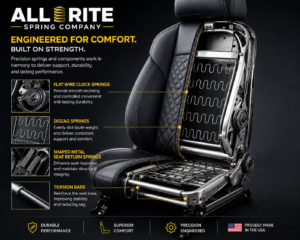

Modern automotive seating has become one of the most technically sophisticated systems in today’s vehicle. What was once viewed primarily as a combination of foam, fabric, and mechanical hardware has evolved into an integrated safety, comfort, and manufacturing platform requiring precision engineering, advanced automation, exceptional process control, and collaborative product development.
Today’s seating systems must satisfy an extraordinary list of requirements. They must provide occupant comfort over hundreds of thousands of miles, contribute to crash performance, reduce vehicle weight, accommodate advanced comfort technologies, integrate electronic systems, support increasingly automated manufacturing environments, and accomplish all of this while meeting demanding cost, quality, and production objectives.
Success is no longer measured solely by the quality of the finished seat.
It is measured by how efficiently that seat can be engineered, manufactured, assembled, validated, automated, and delivered.
At All-Rite Spring Company, we believe every spring, wire form, welded assembly, and structural component should contribute to improving that entire manufacturing system.
Engineering Beyond the Print
Producing a component that meets dimensional specifications is only the beginning.
The greater engineering challenge is designing components that simplify assembly, improve automation, reduce variation, increase durability, and support long-term manufacturing stability.
Every successful program begins by asking questions that extend well beyond the drawing:
- Can assembly become simpler?
- Can automation become more reliable?
- Can variation be reduced before production begins?
- Can fatigue life be improved through optimized geometry or material selection?
- Can multiple components be consolidated into one engineered solution?
- Can manufacturing become more repeatable while reducing total system cost?
- Can the component be designed for manufacturability from the very beginning?
These questions drive our engineering process long before production starts.
Designing Quality Into the Product
Quality should never rely on inspection alone.
The most robust manufacturing systems are built by engineering quality into both the product and the manufacturing process, validating those processes before production begins, and continuously monitoring performance using statistical methods and real-world manufacturing data.
At All-Rite, quality begins during engineering and continues throughout production.
Over the past two years, our customers have experienced near-zero PPM performance across the overwhelming majority of our automotive programs.
That level of performance has not been achieved through inspection alone. It has been achieved through a layered quality philosophy focused on prevention rather than detection.
Our manufacturing systems incorporate technologies and processes including:
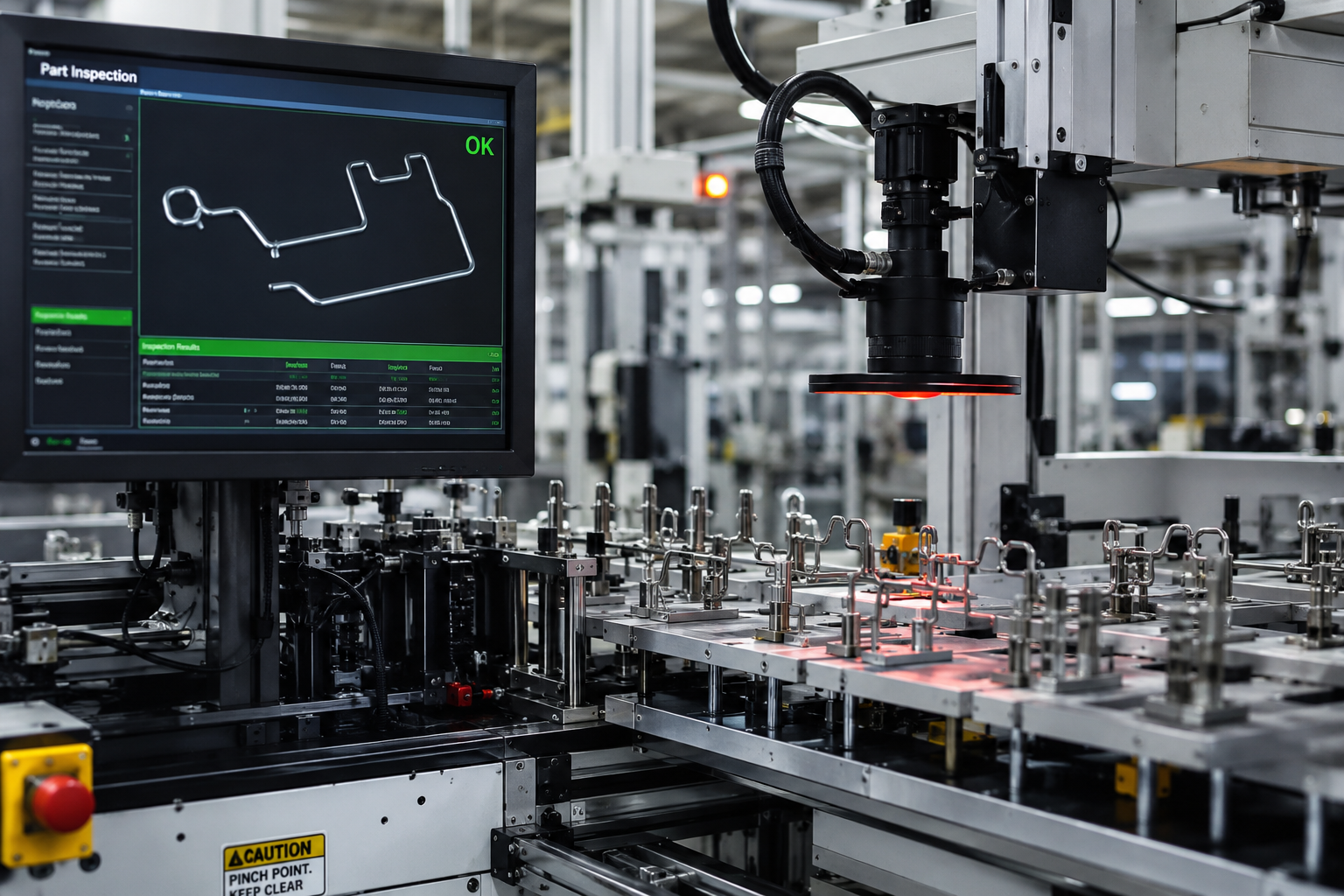
- Automated vision inspection systems for dimensional verification.
- 100% inspection on critical characteristics where appropriate.
- 100% functional testing on safety-critical and application-specific products.
- Statistical Process Control (SPC) to identify variation before nonconforming product is produced.
- Continuous validation of process capability throughout production.
- Root cause analysis with permanent corrective actions.
- Ongoing investment in automation and intelligent process monitoring.
As new technologies become available, we continue expanding automated inspection and functional verification wherever they provide measurable value for our customers.
Because the best quality system is one that prevents defects rather than finding them.
Engineering for Automation
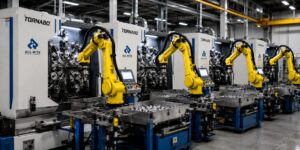
Across the automotive industry, manufacturing competitiveness increasingly depends on automation.
Component design plays a critical role in that success.
Springs, wire forms, welded assemblies, and structural seating components that consistently orient, feed, assemble, and function within automated manufacturing systems help reduce labor, improve throughput, increase Overall Equipment Effectiveness (OEE), and improve long-term process stability.
Engineering for automation means considering not only the finished component, but how it moves through the entire manufacturing process—from raw material through final vehicle assembly.
Expanding Capabilities for Complete Seating Structures
As automotive seating systems continue to evolve, so do the manufacturing capabilities required to support them.
In addition to decades of expertise in precision springs, complex wire forms, and safety-critical mechanical components, All-Rite has significantly expanded its manufacturing capabilities to support larger structural seating applications.
Today our operations include the capacity to manufacture:
- Welded seat frame border wires
- Jointed wire assemblies
- CNC machine-formed seat frame components
- Structural seating wire assemblies
- Complex welded wire structures
- Custom engineered support components for automotive seating systems
These expanded capabilities allow our engineering teams to collaborate earlier in the product development process, helping customers reduce part count, simplify assembly, improve structural performance, optimize automation, and lower total manufacturing cost.
Rather than viewing each component independently, we focus on how complete wire-based systems contribute to a more manufacturable, reliable, and efficient seating assembly.
Turning Manufacturing Data Into Better Engineering
Every production run generates valuable information.
Rather than viewing historical manufacturing data as simply a record of the past, we use it as an engineering resource for future programs.
Decades of production history, combined with statistical analysis, fatigue testing, process capability studies, and customer-specific application experience, allow us to continuously optimize designs based on real manufacturing performance.
This continuous improvement process helps improve:
- Manufacturability
- Fatigue performance
- Material utilization
- Process capability
- Assembly efficiency
- Automation readiness
- Long-term reliability
Each new program benefits from lessons learned across thousands of previous applications.
Supporting Successful Program Launches
Successful launches require far more than quality parts.
They require engineering responsiveness, manufacturing flexibility, disciplined process validation, APQP planning, PPAP execution, and production systems capable of adapting as programs evolve.
Our engineering, quality, manufacturing, and customer support teams work together from prototype through production to help customers manage design revisions, validation requirements, launch schedules, and production ramp-up.
We believe successful launches are built through collaboration—not reaction.
A Long-Term Engineering Partner
For more than eighty years, All-Rite Spring Company has supplied precision springs, welded wire assemblies, structural seat frame components, complex wire forms, and safety-critical mechanical products to demanding industries where consistency, reliability, and engineering excellence matter.
Today, we view our role as much more than manufacturing individual components.
We strive to become an engineering resource that helps customers reduce manufacturing complexity, improve automation, increase process capability, strengthen supply chain resilience, and deliver products with exceptional quality and reliability.
Our objective is simple:
To help engineer better manufacturing systems—not simply better components.
As automotive seating continues to evolve, the companies that succeed will be those that combine engineering innovation, manufacturing excellence, intelligent automation, and collaborative product development.
At All-Rite Spring Company, that has been our objective for more than eight decades.
Because the best component is not simply one that meets specification.
It is one that helps improve the performance of the entire manufacturing system.